
Why Stomach Acid Kills Most Probiotics (And What Parents Should Know)
Dr. Chomba Chuma
MD & Founder, Velobiotics
Most probiotic supplements never survive the journey to your child's gut — and stomach acid is the silent culprit. In this expert guide, Dr. Chomba Chuma breaks down the science of probiotic survival, explains why CFU count alone doesn't tell the whole story, and shares what parents should actually look for when choosing a children's probiotic. If you've ever wondered whether your child's probiotic is really working, this article is essential reading.
Why Stomach Acid Kills Most Probiotics (And What Parents Should Know)
By Dr. Chomba Chuma, MD — Founder of Velobiotics
As a parent, you want to do everything right. You read labels, you research ingredients, and you spend real money on products that promise to support your child's health. So when you buy a probiotic — especially one with a big, impressive CFU count on the label — it's natural to assume those billions of bacteria are actually getting to work inside your child's gut.
Here's the uncomfortable truth: most of them aren't.
In fact, the majority of probiotic bacteria in standard supplements are destroyed long before they ever reach the intestines — the place where they actually need to be to do any good. The culprit? Your child's own stomach acid.
This isn't a fringe concern or a technicality. It's a fundamental biological challenge that the probiotic industry has been quietly grappling with for decades — and it's one that every parent deserves to understand. Because once you know what to look for, choosing an effective probiotic becomes a whole lot easier.
Let's get into the science.
Section 1: The Biology of Digestion — Why the Stomach Is a Battlefield
Your child's digestive system is an extraordinary feat of biological engineering. From the moment food enters the mouth, a cascade of chemical and mechanical processes begins — all designed to break down nutrients, neutralise pathogens, and absorb what the body needs.
The stomach plays a starring role in this process. It secretes hydrochloric acid (HCl), creating an environment with a pH typically between 1.5 and 3.5. To put that in perspective, battery acid has a pH of around 0 — so stomach acid isn't far off. This extreme acidity is intentional: it kills harmful bacteria, viruses, and other pathogens that might enter the body via food or drink.
The problem? Probiotic bacteria — the beneficial kind — are also bacteria. And stomach acid does not discriminate.
What Happens to Probiotics in the Stomach
When a standard probiotic capsule or gummy reaches the stomach, the protective coating (if there is one) often begins to dissolve almost immediately. The live bacteria inside are then exposed to that harsh acidic environment. For most strains, this is fatal.
Studies referenced by the National Institutes of Health on probiotics confirm that probiotic survival rates through the gastric environment can be as low as 1–10% in conventional formulations. That means if your child swallows a capsule containing 10 billion CFU (colony-forming units), as few as 100 million viable bacteria may actually survive to reach the intestines.
And even that figure assumes the bacteria were alive and viable to begin with — which brings us to another challenge entirely.
CFU Count: The Number That Can Mislead Parents
CFU count refers to the number of live, colony-forming bacteria present in a probiotic product — at the time of manufacture. Notice those last four words. Because heat, moisture, light, and time all degrade probiotic viability. By the time a product reaches your pantry shelf, a significant portion of those bacteria may already be dead.
Then the remainder face the gauntlet of stomach acid.
This is why CFU count alone is not a reliable measure of a probiotic's effectiveness. What matters far more is how many live bacteria survive the journey and arrive intact at the site where they're needed: the small and large intestine.
Section 2: The Problem Parents Face — Navigating a Confusing Market
If you've stood in a pharmacy aisle or scrolled through an online store recently, you'll know that the children's probiotic market is overwhelming. There are chewable tablets, gummies, powders, drops, and capsules — each making bold claims about gut health, immunity, and digestive wellness.
What most of these products don't tell you — in plain language, anyway — is how they address the fundamental challenge of stomach acid resistance and probiotic survival.
"I've had hundreds of parents tell me they've tried multiple probiotic products with little noticeable effect. In most cases, the issue isn't the strain selection — it's that the bacteria simply aren't surviving long enough to make a difference." — Dr. Chomba Chuma
As a parent, you're essentially being asked to make a science-based purchasing decision without access to the science. That's not fair, and it's part of why I founded Velobiotics — to close that gap.
The Gummy Problem
Gummies are enormously popular with children because they taste good and feel like a treat rather than medicine. But from a scientific standpoint, they are one of the least effective delivery formats for live probiotics.
Here's why:
- Gummies are manufactured using heat, which kills many bacteria during production
- The sugar and moisture content of gummies degrades bacterial viability over time
- Gummies have virtually no protective mechanism against stomach acid
- Many gummy probiotics contain far fewer viable CFUs than stated on the label by the time they're consumed
This doesn't mean all gummies are useless — but it does mean parents should be asking harder questions about clinical research probiotics backing those products.
The Shelf Stability Illusion
Many probiotics claim to be "shelf stable" — meaning they don't require refrigeration. While advances in strain selection and drying technology have made this more achievable, shelf stability and stomach acid resistance are two entirely different things. A bacterium can survive at room temperature and still be completely destroyed by gastric acid within minutes of ingestion.
Parents deserve to know the difference.
Section 3: The Solution — What Actually Works
Fortunately, the science of probiotic delivery has advanced considerably. Researchers and biotech companies have developed several strategies to improve live probiotics delivery — ensuring that a meaningful number of viable bacteria reach the intestines where they can colonise, multiply, and deliver real health benefits.
The most promising and well-researched of these strategies is microencapsulation.
What Is Microencapsulation?
Microencapsulation is a technology in which individual probiotic bacteria — or clusters of bacteria — are coated in a protective layer of natural materials (such as alginate, cellulose, or lipid-based compounds). Think of it like giving each bacterium its own tiny protective shield.
This microscopic shell serves several critical functions:
- Acid protection: The coating resists the low pH of stomach acid, keeping the bacteria alive during gastric transit
- Moisture and heat resistance: Microencapsulated bacteria are more stable during manufacturing, storage, and transport
- Controlled release: The shell is designed to dissolve at a higher pH — such as the environment found in the small intestine — releasing the bacteria exactly where they need to be
- Extended viability: Microencapsulation significantly extends the shelf life of live bacteria
The result? Dramatically improved probiotic survival rates. While conventional probiotics may deliver 1–10% of their stated bacteria to the gut, well-designed microencapsulated formulations have demonstrated survival rates of 80–90% or higher in clinical settings.
What the Research Says
The body of clinical research on probiotics and microencapsulation is growing rapidly. Multiple peer-reviewed studies have demonstrated that microencapsulated strains show significantly higher viability through simulated gastric conditions compared to unprotected bacteria. Research published in food science and microbiology journals consistently supports microencapsulation as the gold standard for ensuring probiotic survival through the digestive tract.
For parents interested in the broader science of gut health science, the evidence is clear: delivery technology matters as much as the strains themselves.
It's also worth noting that the WHO nutrition guidelines for children increasingly recognise the importance of gut microbiome health in childhood development — and that the gut microbiome's role in immunity, cognition, and metabolic health is well-supported by modern science, including research highlighted by Harvard Health on gut microbiome.
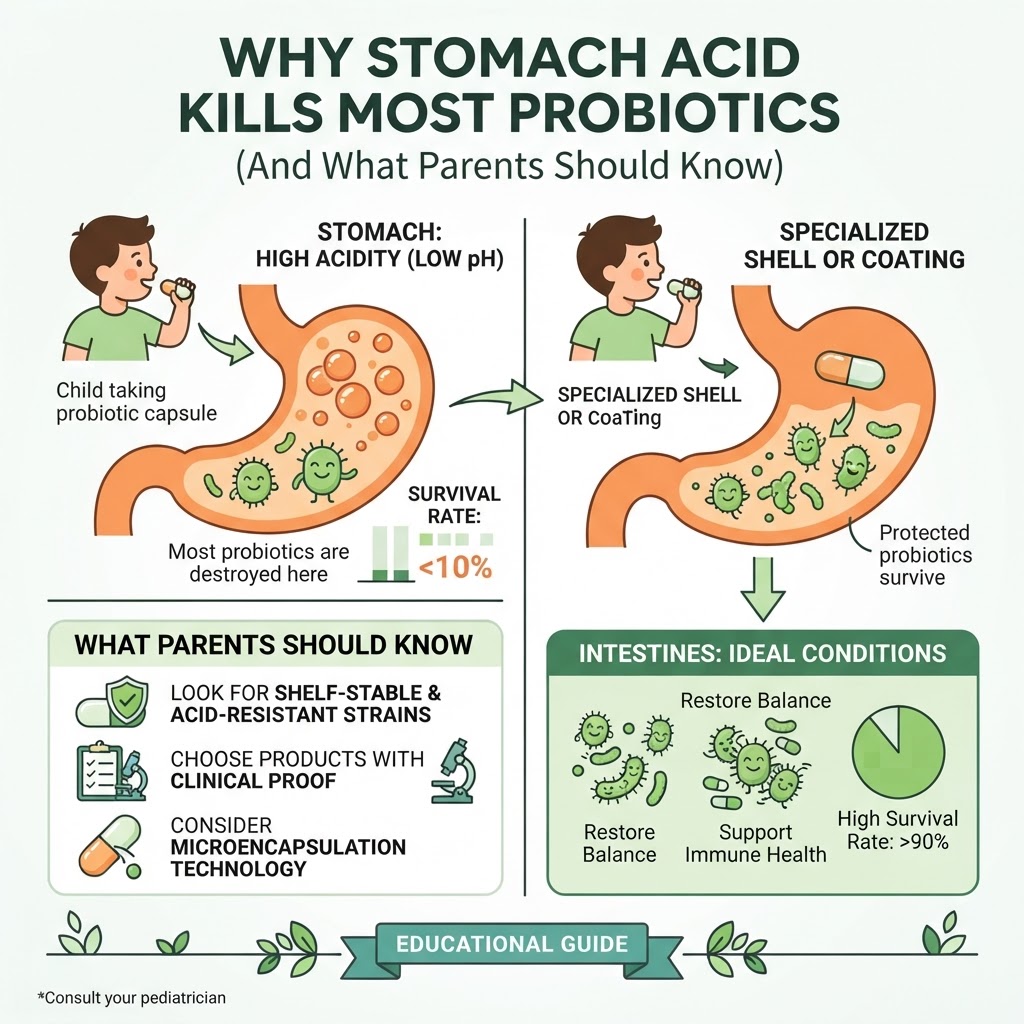
Infographic: Visual summary of key concepts discussed in this article.
Suggested infographic: "The Journey of a Probiotic — Standard vs. Microencapsulated" — showing side-by-side comparison of bacterial survival rates through the stomach and intestines, with pH levels illustrated at each stage of digestion.
Section 4: Practical Tips for Parents — How to Choose the Right Probiotic
Now that you understand the science, let's make it actionable. Here's what to look for — and what to avoid — when choosing a probiotic for your child.
What to Look For
- Microencapsulation technology: Look for this term explicitly on the label or product description. If it's not mentioned, the product likely doesn't use it.
- Clinically studied strains: The most well-researched probiotic strains for children include Lactobacillus rhamnosus GG, Bifidobacterium longum, and Lactobacillus acidophilus. Look for products that name their strains specifically.
- CFU count at expiry, not manufacture: The label should state CFU count through the end of shelf life — not just at the time of production.
- Third-party testing: Reputable brands will have independent lab testing to verify their CFU counts and strain identity.
- Clinical research backing: Ask whether the product has been evaluated in clinical trials or validated by peer-reviewed research.
What to Avoid
- Gummies with vague strain descriptions (e.g., just "probiotic blend" with no strain names)
- Products that only list CFU count at manufacture
- Probiotics with excessive added sugars, artificial colours, or flavourants
- Any product making disease treatment claims without clinical evidence
Supporting Your Child's Gut Beyond Probiotics
Probiotics are most effective when paired with a gut-friendly lifestyle. Here are some simple strategies:
- Feed the good bacteria: Prebiotics (found in foods like bananas, oats, garlic, and onions) are the food source for probiotic bacteria. A diet rich in fibre supports a thriving microbiome.
- Limit unnecessary antibiotics: Antibiotics wipe out both harmful and beneficial gut bacteria. Always discuss necessity with your doctor.
- Reduce ultra-processed foods: High sugar, low-fibre diets disrupt the gut microbiome significantly.
- Encourage outdoor play and varied food exposure: Biodiversity in the environment supports microbial diversity in the gut.
- Track your child's digestive health: Tools like the Poop Patrol gut tracker can help you monitor patterns that indicate gut health changes over time.
Section 5: Why BioKid and Velo16 Technology Change the Conversation
This is where I want to speak to you not just as a scientist, but as someone who built a brand specifically because I saw a gap between what the research said was possible — and what parents were actually getting.
BioKid Probiotics was developed with one non-negotiable principle: every single live bacterium in our formula must have the best possible chance of surviving to your child's gut. That's not a marketing line. It's the engineering challenge we set for ourselves from day one.
To meet that challenge, we developed Velo16 Microencapsulation Technology — our proprietary delivery system that encases each probiotic strain in a multi-layered protective matrix. This matrix is designed to:
- Withstand gastric acid at pH levels as low as 2.0
- Remain stable at room temperature without compromising viability
- Release bacteria in the intestinal environment, where the pH rises and the protective coating dissolves on cue
- Maintain CFU integrity through the full shelf life of the product
The result is a probiotic that doesn't just make promises on a label — it delivers on them inside your child's body.
"Parents shouldn't have to be microbiologists to give their children effective gut support. That's why we engineered Velo16 — to take the uncertainty out of probiotic supplementation." — Dr. Chomba Chuma
BioKid is also formulated with 16 clinically researched strains — selected specifically for relevance to children's gut health, immunity, and digestive comfort. Each batch is independently tested for strain identity and CFU count, so what you see on the label is what your child actually receives.
If you've been wondering whether your child's current probiotic is really working, I'd encourage you to compare formulations carefully — and explore what BioKid Probiotics and Velo16 Microencapsulation Technology can offer. You can learn more and purchase at velobiotics.com.
Conclusion: Informed Parents Make Better Choices
The children's health supplement market can feel like a minefield — and when it comes to probiotics, the science behind delivery technology is genuinely complicated. But the core message is simple:
A probiotic that doesn't survive to the intestines cannot benefit your child's gut.
Stomach acid is a real and significant barrier. CFU count alone doesn't tell you whether those bacteria are alive, viable, or capable of surviving gastric transit. And not all probiotics are created equal — the technology used to protect and deliver live bacteria is just as important as the strains themselves.
By understanding these fundamentals, you're already ahead of most consumers. You can ask better questions, read labels more critically, and choose products backed by genuine clinical research on probiotics and real delivery science.
Your child's gut health is foundational — to their immunity, their digestion, their mood, and their long-term wellbeing. It deserves more than a gummy bear with a vague label. It deserves science that actually works.
📌 Related Reading
Explore more resources to support your child's gut health journey:
- 🔬 Gut Health Science — The Research Behind BioKid
- 💊 BioKid Probiotics — Product Details & Ingredients
- 💩 Poop Patrol Gut Tracker — Monitor Your Child's Digestive Health
- 🥗 Lunchbox Builder — Pack Gut-Friendly Meals for School
- 👨👩👧 Join Our Community Hub — Connect with Other Parents
Dr. Chomba Chuma is a medical doctor and the founder of Velobiotics. He is passionate about making evidence-based gut health science accessible to families across South Africa and beyond. Learn more at velobiotics.com.
Get gut-smart, one email at a time.
Science made simple, practical tips and member-only offers. No spam, unsubscribe anytime.
By subscribing you agree to receive emails from BioKid (Velobiotics). POPIA compliant. Unsubscribe in one click.